
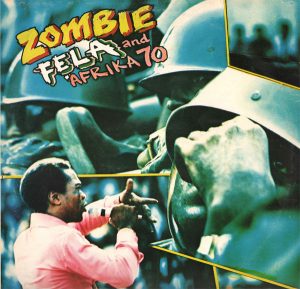
# Fela Kuti and Africa 70 – Zombie
Fela Kuti stands as one of the most influential and politically charged musicians in African music history. By the time of this 1977 release, Kuti had already established himself as a pioneering force in developing afrobeat, a fusion genre that blended traditional West African rhythms with funk, soul, and jazz influences. Kuti's music was never merely entertainment; it was a vehicle for social commentary and political activism against the Nigerian military government. His willingness to address corruption, oppression, and injustice through his art made him both celebrated and controversial in his native Lagos.
Zombie, released on Creole Records in 1977, remains one of Kuti's most potent artistic statements. The album emerged during a turbulent period in Kuti's life and career, following several confrontations with Nigerian authorities. The title track serves as a scathing indictment of the military, with Kuti using the metaphor of "zombies" to describe unthinking soldiers who blindly follow orders without moral questioning. This was bold, dangerous material in its original context, making the album's existence itself an act of defiance.
Musically, the album showcases the full power of Africa 70, Kuti's backing band at the time. The two extended compositions demonstrate the band's mastery of afrobeat's sophisticated formula. The A-side's Zombie stretches over twelve minutes, building from a hypnotic foundation of interlocking percussion and bass lines into a groove that compels movement. Kuti's horn arrangements are razor-sharp, cutting through the dense instrumental texture while his vocals deliver their message with urgent intensity.
The B-side's Follow, Follow maintains the album's political engagement while offering slight sonic variation. At nearly thirteen minutes, this track allows Africa 70 to stretch out further, with extended instrumental passages that showcase the ensemble's cohesion and improvisational prowess. The interplay between horns, guitars, and the rhythm section exemplifies why Kuti's bands were considered among the tightest in world music.
As a vinyl collector's item, this Creole Records pressing captures afrobeat at its most potent and politically engaged. These two tracks alone demonstrate why Fela Kuti earned his place as a musical and cultural revolutionary.